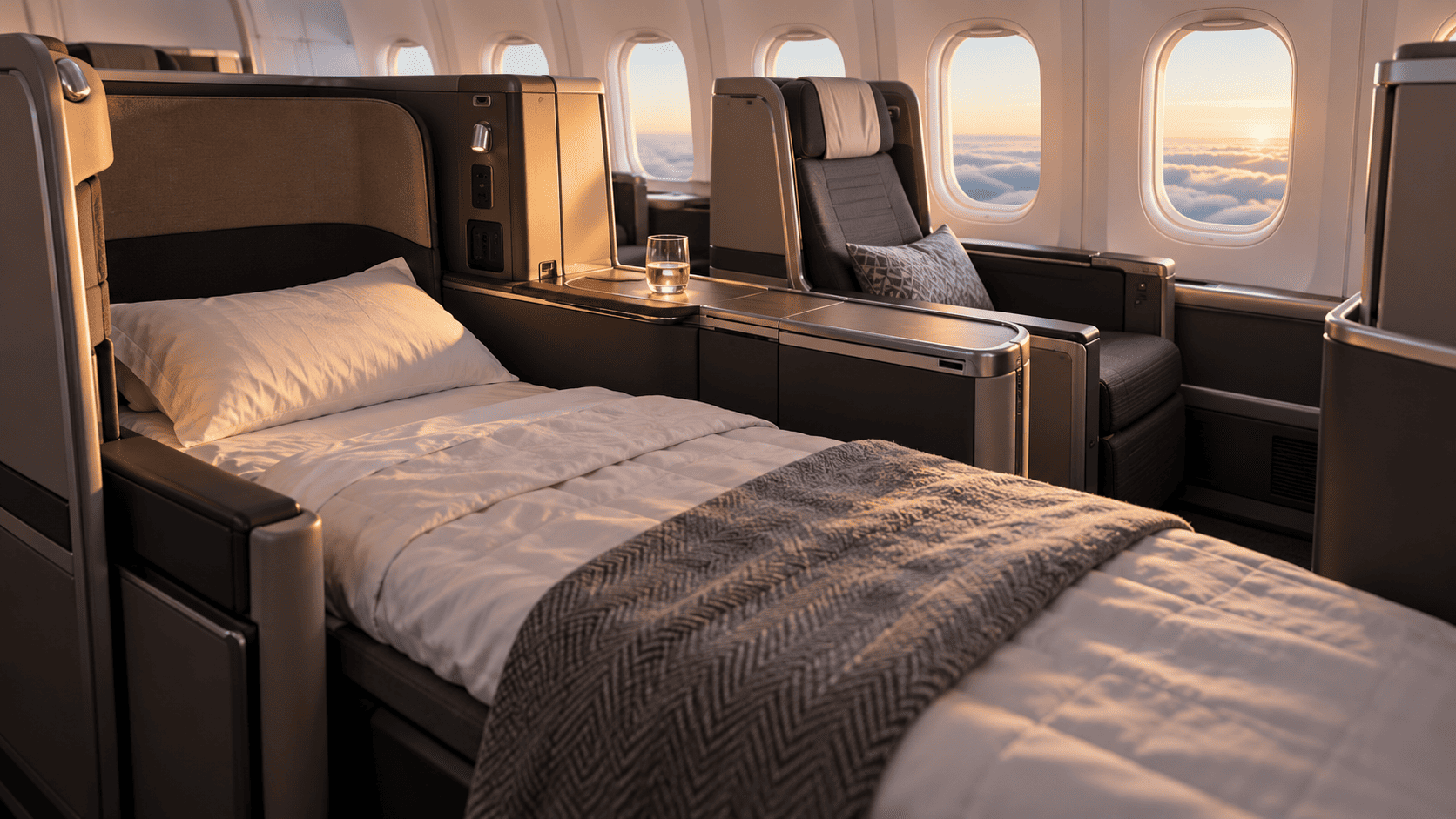
To check whether your business class seat lies flat, expand the flight details in your search results and look for a “lie-flat” seat description. Then confirm the operating airline, scheduled aircraft and cabin layout on the airline’s website. The matching cabin description should explicitly state that the seat converts into a fully flat bed or reclines 180 degrees.
The quickest way to work through it is:
Check the seat description in the flight results. Look for a lie-flat label rather than assuming every business class fare includes a bed.
Identify the aircraft and operating airline. These connect your departure to the correct cabin.
Match the seat map to the airline’s product description. Confirm the sleeping position, then compare features such as bed length and aisle access.
Repeat for connections and the return flight. Different flights within one booking can have different seats.
This matters most when sleeping is the reason you’re paying for business class. Before comparing meals, lounges or entertainment, establish whether the seat on your overnight flight actually becomes a bed.
Does every business class seat lie flat?No. Business class can include fully flat beds, angled-flat seats or reclining chairs. Some short-haul cabins provide extra space through an empty neighbouring seat rather than a larger seat that converts into a bed.
British Airways’ Club Europe illustrates the difference: the airline describes a short-haul business class cabin with the middle seat kept free. That is a different seating experience from a long-haul flat-bed cabin.1
Route length and aircraft size can help you narrow your search, but neither confirms the seat. Singapore Airlines, for example, has published specifications for fully flat business class beds on its single-aisle Boeing 737-8.2
Check the specific cabin before paying, particularly when comparing short-haul flights, domestic services or connecting itineraries.
Understand fully flat, angled-flat and reclining seatsThe distinction comes down to the position of your body when the seat is fully extended.
Seat type | Sleeping or resting position | What to look for |
Fully flat | A horizontal bed that lets you lie down | An explicit description such as “fully flat bed” or “180-degree recline” |
Angled-flat | An extended sleeping surface that remains sloped | Wording that identifies an angled bed rather than a horizontal one |
Reclining | A tilted backrest, sometimes with a leg rest | A recline description without a claim that the seat becomes a flat bed |
For an overnight flight, choose a fully flat seat if lying horizontally is your priority. An angled-flat seat may let you stretch out, but it does not provide the same position.
Also distinguish seat pitch from bed length. Pitch measures the distance between corresponding points on successive seats; it does not tell you whether a seat becomes horizontal. A generous legroom figure therefore cannot confirm a flat bed.
Once you have established the sleeping position, compare the features that matter to you. Taller passengers may need to examine bed length and foot space. Solo travellers may prioritise privacy and direct aisle access. Couples may prefer seats positioned together.
Check the seat on your exact flightStart with the flight you would book, then follow its details to the corresponding cabin.
On Google Flights, select your route, dates and business class, then expand the individual flight result. Look for the seat-type information in the amenities. Where a lie-flat description is displayed, use it to identify a promising option before checking the airline’s own information.
If you use Seats.aero, its published instructions describe a similar process: open Flight details, examine each segment and look for the “Lie-flat seats” badge. The service also explains that some lie-flat flights may lack a badge because its data is incomplete. A missing label therefore needs further checking.3
Next, open the airline’s booking result or manage-booking page and find the aircraft and seat map. You are looking for agreement between three things:
Your flight details: the operating airline, departure date and flight number.
The seating layout: the business class configuration shown for that departure.
The product description: the sleeping position offered by that cabin.
If the seat type remains unclear, ask a focused question before payment:
“Does business class on flight [number] on [date] have fully flat beds, and which aircraft layout is currently scheduled?”
Identify the operating airline, flight number and aircraft configurationFirst, find “operated by” in the flight details. On a codeshare booking, the airline selling the ticket may differ from the airline flying the aircraft. Google’s published booking guidance explains this distinction and identifies the detailed flight view as the place to find the operating carrier.4
Use the operating airline’s fleet and cabin information for your seat check.
Then note the complete aircraft designation where available—for example, Boeing 777-300ER rather than simply “777.” This narrows the search, but you may still need to choose between several seating layouts.
The aircraft model identifies the plane; the configuration identifies its interior layout. If an airline lists multiple configurations for that model, compare them with the map attached to your departure. The number of business class rows and arrangement of seats can help you identify the matching version.
Do not substitute another flight on the same route just because its cabin is easier to find. Keep the flight number and date attached to your search.
Compare the official seat map and cabin descriptionUse the seat map to understand the arrangement and the cabin description to confirm the bed.
For example, a 1-2-1 layout has one seat beside each window and two seats in the centre. It helps you understand where you would sit and how the seats relate to the aisles. It does not, by itself, establish the sleeping angle.
Read the accompanying description for the features the diagram cannot reliably show:
Bed position: does it explicitly become fully flat?
Bed dimensions: is the published length suitable for you?
Aisle access: can you leave the seat without stepping past another passenger?
Privacy: does the seat have a divider or door?
Foot space: does the bed extend into a footwell?
An airline’s cabin photographs can help you visualise those features once you have identified the matching product. Avoid choosing a flight on the strength of a photograph of an unspecified business class cabin.
If the booking map and product description appear inconsistent, send both to the airline or booking agent and ask which applies.
Check each segment of a connecting itineraryA business class itinerary can contain more than one seat experience. Check the long-haul flight, feeder connections and return journey individually.
Suppose you are comparing two overnight itineraries. Both include a flat bed on the main flight, but one has a short connection in a reclining business class seat. That may be acceptable if your priority is sleeping during the longest sector. The important point is knowing which flight provides the bed before comparing the prices.
Also check the booked cabin on every segment. A reclining seat in business class and a connection booked in economy are different situations; neither should be hidden behind an itinerary-level business class label.
Thebusiness class booking checklist covers the wider checks before payment, including the cabin on each flight and the ticket conditions.
Whencomparing cheaper business class flights, compare the seat on the overnight sector alongside the fare and connection time. That gives you a more useful comparison than the cabin label alone.
Which airlines offer lie-flat business class seats?Airlines offering lie-flat business class products include Qatar Airways, Emirates and Singapore Airlines. Look for the named product or aircraft cabin, then match it to your departure.
Airline | Product or cabin to identify | Published flat-bed details |
Qatar Airways | Qsuite-equipped Boeing 777-200LR | The airline’s published aircraft specification lists flat-bed seats with 180-degree recline.5 |
Emirates | Airbus A350 Business Class | Its A350 cabin publication describes lie-flat seats arranged 1-2-1.6 |
Singapore Airlines | Boeing 737-8 Business Class | Itsdescribes fully flat beds measuring 76 inches.7 |
These are examples to recognise during a search, rather than a complete list of airlines or routes. Product names are useful because they give you something more precise to check than “business class.”
When comparing two flat-bed options, move beyond the yes-or-no question. Compare the bed dimensions, layout and privacy features to decide which better suits your journey.
What if the aircraft or seat assignment changes?Check the replacement seat map and cabin description when you receive an aircraft-change notification. A different seat number may still provide the same type of bed; a different cabin can change the sleeping position or layout.
Start by establishing what changed:
Open the updated booking. Check the aircraft and seat assignment.
Compare the replacement cabin. Confirm whether it still has fully flat beds and the features you selected.
Contact the airline or booking agent if the difference matters. Ask what alternatives are available under your booking conditions.
Keep the original booking confirmation and any written cabin information. They will help you explain the difference clearly.
British Airways’published Conditions of Carriage, for example, state that a particular seat is not guaranteed and assignments can change for operational, safety or security reasons. Check the conditions that apply to your own booking before cancelling or accepting an alternative.9
Make one final seat check when you check in, especially if the airline has notified you of a change. By then, you should know both that your scheduled seat becomes a flat bed and where it sits within the cabin.